What Is Decision Fatigue and How to Beat It
What is decision fatigue?
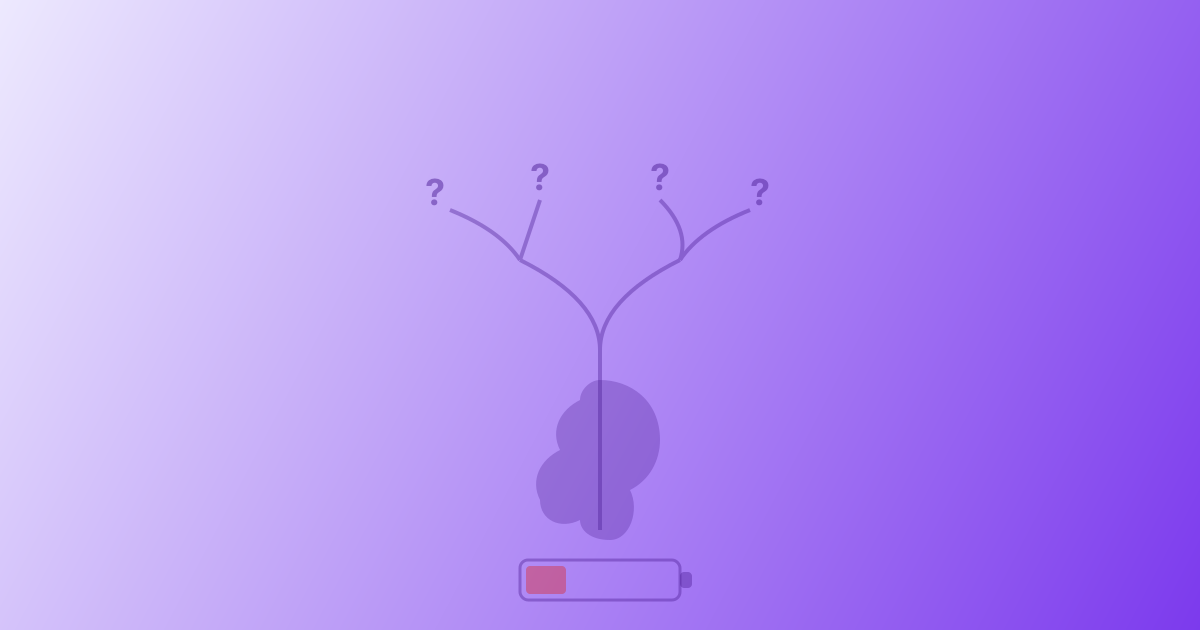
Decision fatigue is the deterioration of your ability to make good decisions after a long session of decision-making. Every choice you make — from what to wear to how to reply to an email — draws from a limited daily pool of mental energy.
By the afternoon, that pool is drained. That's why you can lead a productive morning meeting but can't decide what to have for dinner.
The term was popularized by social psychologist Roy Baumeister, based on research showing that willpower and decision-making share the same mental resource — and it's finite.
How do I know if I have decision fatigue?
Common signs:
- You avoid making choices — putting off emails, meals, or plans
- You default to the easiest option — scrolling instead of doing
- You feel irritable or overwhelmed by simple questions ("What do you want for dinner?")
- You make impulsive choices — buying things you don't need, snapping at people
- You feel mentally exhausted despite not doing anything "hard"
If this sounds like your every evening, you're not broken. Your brain is just out of decision fuel.
Why is decision fatigue worse with ADHD?
ADHD brains already have weaker executive function — the cognitive system responsible for planning, prioritizing, and choosing. That means:
- You start with less capacity — your "decision pool" is shallower
- You spend more on each decision — because ADHD makes filtering options harder
- You recover slower — rest doesn't recharge ADHD brains as efficiently
The result: ADHD people hit decision fatigue earlier and harder than neurotypical people. It's not a character flaw — it's a neurological reality.
Why is it worse with anxiety?
Anxiety adds a layer of consequence scanning to every decision. Instead of just choosing, anxious brains also:
- Imagine worst-case outcomes
- Ruminate over past "wrong" choices
- Seek certainty before deciding (which rarely comes)
This means a simple decision like "Should I go to the gym?" becomes a 10-minute internal debate weighing energy levels, social anxiety, weather, schedule conflicts, and guilt.
How do I beat decision fatigue?
1. Reduce the number of decisions you make
The most effective strategy. Eliminate choices before they happen:
- Meal prep on Sundays — decide once, eat all week
- Capsule wardrobe — fewer clothes = fewer morning decisions
- Default routines — same breakfast, same morning order, same workout day
Steve Jobs wore the same outfit daily for this exact reason. You don't need to go that far, but every default saves a decision.
2. Make important decisions first
Your best decision-making happens in the morning (or whenever you're freshest). Front-load:
- Creative work
- Big life decisions
- Financial choices
- Hard conversations
Save autopilot tasks (laundry, cleaning, routine emails) for when you're drained.
3. Use external decision tools
When you can't decide, let something else decide for you. This is not giving up — it's strategic offloading:
- Flip a coin (seriously — your reaction to the result tells you what you actually want)
- Use a decision app like Help! What Now? to pick from your own pre-built options
- Ask someone else to choose (restaurants, movies, weekend plans)
4. Set decision deadlines
Give yourself a time limit: "I'll decide in 2 minutes or go with option A." Parkinson's Law applies to decisions too — they expand to fill the time you give them.
5. Batch similar decisions
Group decisions by type and handle them in one session:
- Meal decisions: Plan all meals on Sunday
- Outfit decisions: Pick 5 outfits on Sunday night
- Work priorities: Decide your top 3 tasks at the start of each day, not throughout
6. Lower the stakes
Most decisions don't matter as much as your brain thinks. Ask: "Will this matter in a week?" If no, pick the first acceptable option and move on.
The fancy term for this is satisficing (vs. maximizing) — choosing "good enough" instead of "the best." Research shows satisficers are happier than maximizers.
What's the difference between decision fatigue and executive dysfunction?
| Decision Fatigue | Executive Dysfunction | |
|---|---|---|
| Cause | Too many decisions deplete mental energy | Neurological difficulty with planning/starting tasks |
| Who it affects | Everyone (worse with ADHD/anxiety) | Primarily ADHD, autism, depression |
| When it's worst | End of day / after many choices | Can happen anytime, even when rested |
| Fix | Reduce decisions, rest, defaults | External structure, tools, medication |
They often overlap. If you have ADHD, you likely experience both — and each makes the other worse.
References
- Baumeister, R. F., & Tierney, J. (2011). Willpower: Rediscovering the Greatest Human Strength
- Schwartz, B. (2004). The Paradox of Choice: Why More Is Less
- Vohs, K. D., et al. (2008). Making choices impairs subsequent self-control. Journal of Personality and Social Psychology